
The Prevent the Careless Use of Fire Act 1865 was introduced as the first legislation for rural fire management practices in Queensland. This prompted the beginning of a number of rural landowners banding together to protect their properties and communities. But it wasn't until after the introduction of the Rural Fires Act 1927 that the first Rural Fire Board was formed. Unfortunately, the board was suspended during the Great Depression in 1931.
After World War II, rural communities across Queensland again started organising their own local volunteer firefighting services – the Bush Fire Brigades. This led to the reformation of the Rural Fires Board in 1948, seeing a period of exponential growth for rural brigades across the state, growing from approximately 350 brigades in the 1950s to around 1,400 brigades in the early 1980s.
In 1990, the Rural Fires Board was reconstructed into the Rural Fires Council, becoming part of the Queensland Government Department of Emergency Services, and then Queensland Fire and Emergency Services, combining Urban Fire Services, Rural Fire Services, Ambulance and State Emergency Services. This amalgamation saw the provision of better equipment, funding, training and communication to our brigades.
Today, we are the Rural Fire Service Queensland, part of the Queensland Fire Department. About 28,000 unpaid volunteers serving in about 1,400 brigades across the state provide dedicated fire services to 93% of Queensland.
The logo
The RFSQ logo has evolved over the years of the service.
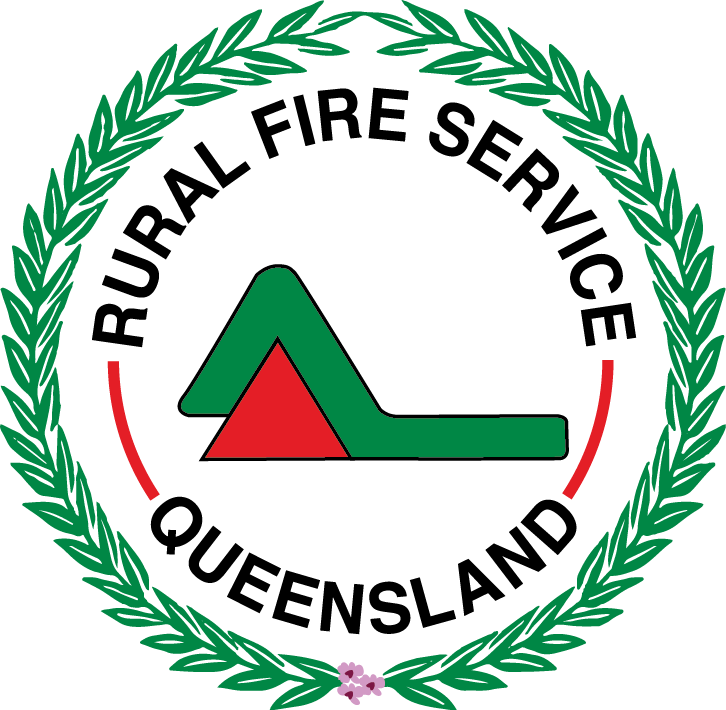
In April 1979, the centre of our logo was approved by the then Minister for Mines, Energy and Police after consultation with a number of design companies and multiple submissions. The successful company explains the logo.
"The upper band of the logo designates the foliage that is the base of any bushfire. The triangle designates fire that threatens the landscape. The universal symbol for fire is a triangle depicting fuel, oxygen and ignition."
The new logo, which was approved by the Department of Premier and Cabinet in 2016, pays tribute to the history of the RFSQ by retaining the original logo in the centre of the image. The logo however now incorporates a wreath, symbolic of our inclusion into the larger Queensland Fire Department and depicts the Cooktown Orchid – the floral emblem of Queensland.
The Volunteer Charter
The RFSQ Volunteer Charter is an agreement between the State of Queensland, the department and the Rural Fire Brigades Association Queensland to ensure the State of Queensland and the department will commit to consultation with volunteers regarding matters which might reasonably be expected to affect volunteers.
The first one hundred brigades
This list has been reproduced from the 1960/61 Annual Report of the Rural Fires Board, at which time 358 brigades were registered. Many of these brigades are still in existence today, while some have been merged with other brigades due to the spread of the urban development.
- Glasshouse Mountains
- Lagoon Pocket
- Dagun
- Byfields
- Kandanga
- Amamoor
- Caboolture
- Thangool
- Langshaw
- Gordonbrook
- Dangore
- Wooroolin
- Wamuran Basin
- Nidi Gully
- Greymare
- Wamuran
- Evelyn
- Wellshot-Portland
- West Burleigh
- Morgen North
- Malboona
- Wyandra
- Wyangarie No. 1
- McKinlay Shire
- Pie Creek
- Granada
- Bimerah
- Cunnamulla
- Valetta
- Nelia North
- Wakefiled
- Ernestina
- Ducklo
- Mungallala
- Langlo Crossing
- Cooladdi
- Strathlea
- Eudlo
- Balkan States
- North Ilfracombe
- East Darr
- Aspley
- Warrnambool
- Leeson
- Middle Creek
- Ironpot
- Gallipoli
- Luckham
- Toogoolawah
- Sandy Ridges
- Bollon
- Adavale
- –
- Summit
- Cedar Vale
- Barabon
- Gin Gin
- Coominglah
- Acheron Creek
- Marmor
- Alton Downs
- Bracewell
- Calliope
- Butlerville
- Machine Creek
- Ambrose
- East End
- Ridgelands
- Veteran
- Banana
- Raglan
- Baralaba
- Tartulla
- Jambin
- Willawa
- Moura
- Valentine Plains
- Olio
- Wardsdale
- Kunioon & Hodgleigh
- Beechal Creek
- Nebine
- –
- Mount Murchison
- Brooloo
- Dalma
- Dixalea
- Wattlebank
- Jardine
- Morella
- Bouldercombe
- Werna-Wokingham
- Bukali
- Rossmoya
- Dululu
- East Springsure
- Mothar Mountain
- Catsworth
- Orange Creek
- Kybong